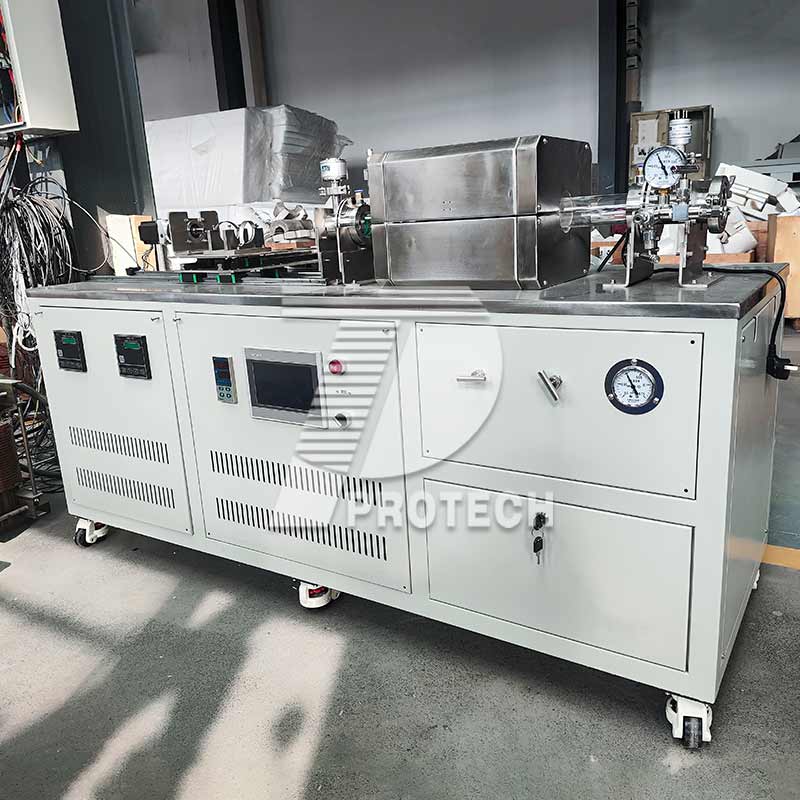
KrsMuffle Furnace,Tube Furnace,Vacuum Furnace,Atmosphere FurnacKrsMuffle Furnace,Tube Furnace,Vacuum Furnace,Atmosphere FurnacIn the CVD (chemical vapor deposition) process, temperature is the core parameter that affects the deposition rate, crystal structure and performance of thin films, and its control accuracy directly determines the quality of the final product. Combining the existing technical solutions and control logic, improving the temperature control accuracy requires multi-dimensional parameter coordinated regulation and intelligent algorithm optimization.KrsMuffle Furnace,Tube Furnace,Vacuum Furnace,Atmosphere FurnacKrsMuffle Furnace,Tube Furnace,Vacuum Furnace,Atmosphere Furnac1. Multi-parameter coordinated temperature closed-loop control systemKrsMuffle Furnace,Tube Furnace,Vacuum Furnace,Atmosphere FurnacKrsMuffle Furnace,Tube Furnace,Vacuum Furnace,Atmosphere FurnacThe temperature distribution in the CVD reactor is affected by multiple factors such as substrates, heating elements and heat transfer media, and it is necessary to achieve precise control through multi-parameter linkage:KrsMuffle Furnace,Tube Furnace,Vacuum Furnace,Atmosphere Furnac
KrsMuffle Furnace,Tube Furnace,Vacuum Furnace,Atmosphere Furnac
Dual feedback regulation of substrate top and bottom temperaturesKrsMuffle Furnace,Tube Furnace,Vacuum Furnace,Atmosphere Furnac
KrsMuffle Furnace,Tube Furnace,Vacuum Furnace,Atmosphere Furnac
By obtaining the current top temperature of each substrate, the preset top average temperature and the average temperature of the bottom of the substrate carrier, combined with the number of substrates, the bottom heating temperature is dynamically calculated to ensure the overall heating uniformity of the carrier. For example, when the top temperature of a substrate deviates from the preset value, local compensation can be achieved by adjusting the bottom heating power of the corresponding area.KrsMuffle Furnace,Tube Furnace,Vacuum Furnace,Atmosphere Furnac
KrsMuffle Furnace,Tube Furnace,Vacuum Furnace,Atmosphere Furnac
Dynamic adaptation of heat transfer gas component coefficientKrsMuffle Furnace,Tube Furnace,Vacuum Furnace,Atmosphere Furnac
According to the deviation between the current top temperature of each substrate and the preset value, the component coefficient of the heat transfer gas (such as the ratio of inert gas to reactive gas) is adjusted in real time to optimize the heat conduction efficiency and reduce temperature fluctuations. For example, in the early stage of deposition, the thermal conductivity of the heat transfer gas can be increased to accelerate the temperature rise, and the coefficient can be reduced in the stable stage to suppress overshoot.KrsMuffle Furnace,Tube Furnace,Vacuum Furnace,Atmosphere FurnacKrsMuffle Furnace,Tube Furnace,Vacuum Furnace,Atmosphere Furnac2. Optimization and upgrading of PID control algorithmKrsMuffle Furnace,Tube Furnace,Vacuum Furnace,Atmosphere FurnacThe traditional PID controller is susceptible to interference from nonlinear systems, and the adaptability needs to be improved through algorithm improvement:KrsMuffle Furnace,Tube Furnace,Vacuum Furnace,Atmosphere Furnac
KrsMuffle Furnace,Tube Furnace,Vacuum Furnace,Atmosphere Furnac
Segmented PID parameter configurationKrsMuffle Furnace,Tube Furnace,Vacuum Furnace,Atmosphere Furnac
The variable speed integral PID algorithm is used to apply different proportional (P), integral (I), and differential (D) parameters in the temperature rise stage, overshoot stage, and stable stage. For example, the P value is increased in the temperature rise stage to shorten the response time, and the I value is reduced in the stable stage to avoid overshoot.KrsMuffle Furnace,Tube Furnace,Vacuum Furnace,Atmosphere Furnac
KrsMuffle Furnace,Tube Furnace,Vacuum Furnace,Atmosphere Furnac
Sensor linearization and environmental compensationKrsMuffle Furnace,Tube Furnace,Vacuum Furnace,Atmosphere Furnac
The nonlinear characteristics of the temperature sensor are linearized by electronic circuits or programs to expand the effective measurement range; at the same time, the influence of external factors on the sensor accuracy is reduced through compensation of parameters such as ambient temperature and air pressure. For example, in a high temperature environment, the measurement error can be corrected by the thermocouple cold end compensation algorithm.KrsMuffle Furnace,Tube Furnace,Vacuum Furnace,Atmosphere Furnac
3. Strengthening of hardware system and calibration mechanismKrsMuffle Furnace,Tube Furnace,Vacuum Furnace,Atmosphere Furnac
KrsMuffle Furnace,Tube Furnace,Vacuum Furnace,Atmosphere Furnac
Selection of high-precision sensing and heating elementsKrsMuffle Furnace,Tube Furnace,Vacuum Furnace,Atmosphere Furnac
Select high-performance temperature sensors (such as platinum resistance PT1000) and partitioned independent heating modules to ensure that the temperature signal acquisition resolution reaches ±0.1℃ and the heating power adjustment accuracy is 0.1%.KrsMuffle Furnace,Tube Furnace,Vacuum Furnace,Atmosphere Furnac
KrsMuffle Furnace,Tube Furnace,Vacuum Furnace,Atmosphere Furnac
Periodic calibration and system diagnosisKrsMuffle Furnace,Tube Furnace,Vacuum Furnace,Atmosphere Furnac
Regularly calibrate sensors, heating elements and control modules to establish a temperature deviation database. For example, calibrate sensor drift through a blackbody furnace, use an infrared thermal imager to detect the temperature uniformity of the heating area, and replace aging components in time to maintain system stability.KrsMuffle Furnace,Tube Furnace,Vacuum Furnace,Atmosphere Furnac
KrsMuffle Furnace,Tube Furnace,Vacuum Furnace,Atmosphere Furnac
4. Special optimization strategies in application scenariosKrsMuffle Furnace,Tube Furnace,Vacuum Furnace,Atmosphere Furnac
KrsMuffle Furnace,Tube Furnace,Vacuum Furnace,Atmosphere Furnac
Multi-substrate uniformity controlKrsMuffle Furnace,Tube Furnace,Vacuum Furnace,Atmosphere Furnac
In mass production scenarios, optimize the layout of heating elements (such as annular partition heating) through substrate stage temperature gradient simulation and heat transfer model simulation to ensure that the temperature difference between each substrate is ≤±1℃.KrsMuffle Furnace,Tube Furnace,Vacuum Furnace,Atmosphere Furnac
KrsMuffle Furnace,Tube Furnace,Vacuum Furnace,Atmosphere Furnac
Adaptation to extreme process conditionsKrsMuffle Furnace,Tube Furnace,Vacuum Furnace,Atmosphere Furnac
For high temperature (>1000℃) or low pressure CVD process, high temperature resistant ceramic heating tube and vacuum sealing design are adopted, combined with PID-fuzzy control hybrid algorithm, to balance fast response and control accuracy, and avoid film defects caused by temperature overshoot.KrsMuffle Furnace,Tube Furnace,Vacuum Furnace,Atmosphere Furnac
KrsMuffle Furnace,Tube Furnace,Vacuum Furnace,Atmosphere Furnac
Through the coordinated application of the above technical means, the temperature control accuracy of CVD process can be improved to within ±0.5℃, significantly improving the uniformity of film thickness and crystal quality consistency, providing support for large-scale production in high-end fields such as semiconductors and optoelectronic materials.







 English
 简体中文
简体中文 Français
 日本語
日本語 بالعربية
 한국어
한국어 Português
 Русский
 Español